
Tilderu Street 2C, Salaspils – The First Four-Apartment Building in Tilderu kvartāls
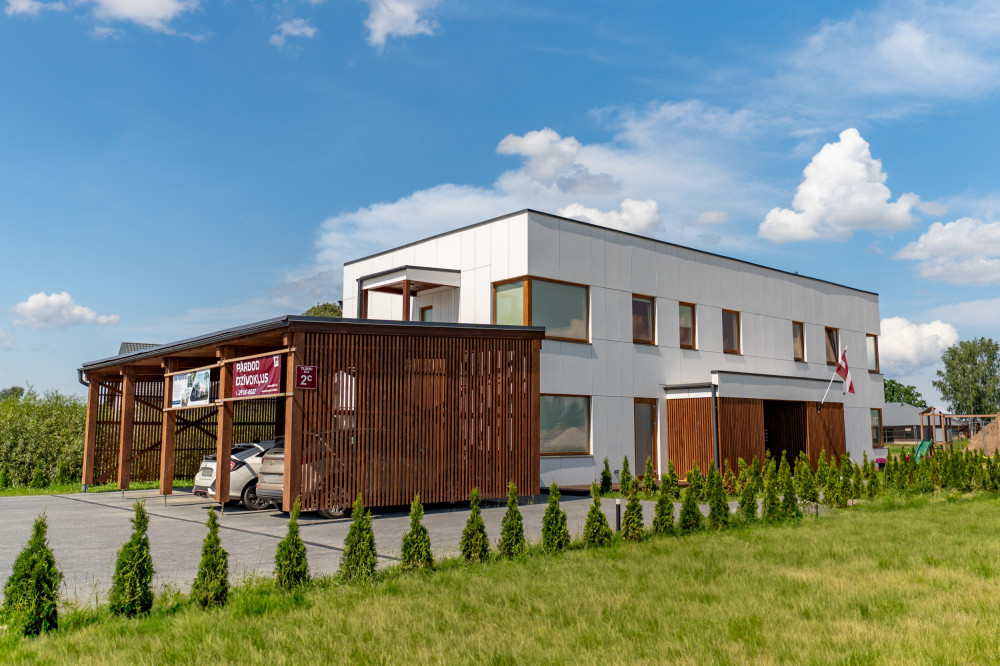
Tilderu Street 2C was the project through which MM Properties entered the apartment building segment. Until then, the company’s experience had mainly been related to private houses and detached residential projects, which made this building an important transition point. The task was not simply to construct a small apartment building, but to transfer the approach developed in the private housing segment into a new format without losing quality, technical logic, and everyday usability.
The project included four apartments — two three-room and two four-room units. From the beginning, it was important to ensure that the building would not feel like a compromise solution in which a small volume was used only to maximise floor area while paying less attention to everyday use. For that reason, the layouts were developed with real family life in mind rather than as a purely theoretical division of spaces.
One of the most important solutions in this project was technical independence for each apartment. Every apartment was equipped with an individual heat pump, its own heat recovery ventilation system, and underfloor heating. This approach was chosen deliberately in order to preserve a greater level of independence for each owner and to avoid the typical situation in which all residents depend on one shared system. As a result, each apartment gained clearer control over its indoor climate, energy use, and everyday comfort.
From the structural and architectural point of view, this project was also important as a basis for a broader timber-based approach. The project was developed using timber construction logic, while the CLT staircase in the common stairwell became one of the elements that added not only function, but also spatial quality. The exterior was finished with light-toned fibre cement panels, maintaining a restrained and modern architectural language that made sense for long-term use.
The most important outcome of this project was not only the completed building itself, but also the experience it provided for the next development stages. Tilderu Street 2C made it possible to test in practice which solutions worked well, where improvements were needed, and how a small-scale apartment building could deliver a higher quality of living. This experience later became the basis for the next stages of Tilderu kvartāls, including projects of a larger scale.
For that reason, this building should be seen not only as the first completed four-apartment block, but as the starting point for the broader approach to apartment building development. It showed that even a small-scale project can be technically organised, functional, and suitable for long-term living when decisions are made thoughtfully and consistently.